Gaming gets trodden on sometimes because it's "badly written", "stupid" or some other, rather similar descriptive terms. And it's true, often games are a bit stupidly written: the plots are overly evident, simplistic and clumsy - and gamers easily forgive this kind of stuff in favor of playability, because, as an acquaintance of mine put it, "you don't have time to listen to follow the plot if you're too busy shooting everything in sight."
I find this unfortunate. I wish that gamers - the core group that actually consumes games and game culture - would demand something better. Unfortunately a large portion of gamers are happy as clams to simply get the next FIFA, NHL and Battlefield off the shelves, which really isn't that good for originality, risk taking and cool new ideas in the gaming business.
Luckily, the fringe, underground and indie markets are slowly gaining ground. Services like the XBLA (Xbox Live Arcade), PSN Store (PlayStation Network Store) and Steam have made it possible for anything that seems marketable to be on the market. You could make your cool ideas into a real, finished product but have no means of marketing it? Now you do.
Now, "indie" or any other of these labels doesn't mean a game is good. Not even close. But it means that original ideas finally have a foothold on the business: you don't have to try to get a footing through the coder scene (although it still helps) - you can go to a broader audience straight off the bat.
This means there's a lot of, well, not that good games (I'd rather not use the term swill, although sometimes it feels apt) circulating out there: topical spinoffs of something that was good, with very minor tweaks to the gameplay as such. But it also means that sometimes, you find absolute diamonds: blasts from the past, with a polished, "now" kind of a finish; storytelling treasures, psychological exercises made interactive, explorations into the human psyche...
Game writing is often mediocre and sometimes downright bad. But sometimes it gives you a slice of life that is worth a good book or a great movie. I've played games that have made me laugh, cry and live the plot with the characters. On this topic, I'll be pondering the Walking Dead (the game, not the comic or the tv series) next time.

This work is licensed under a Creative Commons Attribution Non-commercial International 4.0 Unported License.
maanantai 11. helmikuuta 2013

perjantai 8. helmikuuta 2013
Copyright Culture
Yesterday, the Europian Union Court of Human Rights made a declaration about the Copyright monopoly laws. Here's a news clipping about it.
"The European Court of Human Rights has declared that the copyright monopoly stands in direct conflict with fundamental Human Rights, as defined in the European Union and elsewhere. This means that as of today, nobody sharing culture in the EU may be convicted just for breaking the copyright monopoly law; the bar for convicting was raised considerably. This can be expected to have far-reaching implications, not just judicially, but in confirming that the copyright monopoly stands at odds with human rights."
You can read the full article here:
http://falkvinge.net/2013/02/07/court-of-human-rights-convictions-for-file-sharing-violates-human-rights/
I'm not going to discuss the whole article here, so I'll just summarize some points a bit outside it's area that I found important as well. In short, the European Convention outlines that an individual has the right to produce, reproduce and share culture and the current monopoly laws concerning copyrights limit this freedom, which is considered a base right of all human beings. It's a bit more defined and refined version of the 1st Amendment, for any American (or other) readers that may not be familiar with it.
There's been discussion about how the monopoly laws could be considered unjust, even degrading towards a single person, persona and personal rights, but no one's really done anything about it. Until yesterday. The EU Court of Human Rights in Strasbourg isn't exactly a small fish in this pond: it could be considered the single largest authority on issues concerning human rights, since the UN council and other chairs don't really give declarations anymore.
Some have lauded this as a victory for online piracy, which it is not. Piracy is still illegal, as it should be, but an individual is allowed to use and share culture without fear of unjust prosecution, what could be considered corporate blackmail and wholly unbased reimbusements that will leave an individual and his seventh son's seventh son in debt to a company that serves no one's rights, despite very vocal claims otherwise. It's still possible to get convicted for sharing content clearly owned by someone else, but now there needs to be a reason to do so in the EU.
What this is, is the first step towards copyright laws and copyright culture that could be viewed as even close to modern. It is a victory of the individual and the culture over unfeeling corporate power. (Not a socialist victory, just an individual one, mind.)
It's a start.
tiistai 29. tammikuuta 2013
Underlying themes
I'm not one to ban old books for racist or maybe-racist content: if we block the past, the risk of repeating it grows exponentially. Yes, Uncle Tom's Cabin, Robinson Crusoe and Huckleberry Finn display black people in rather unfavorable light. But that's how they were displayed back then.
If we block the popular culture of the past, we're sort of erasing history as we do it. And if we refuse to acknowledge that our history wasn't all sunshine and lollipops we run the risk of repeating it. What I'd much more rather see is people reading these books, Ten Little Nigger Boys still on the cover of the now Then There Were None and people actually discussing these things in their cultural context.
There's a movie out with just such a theme now: Django Unchained. I haven't seen it yet, but I can make a few educated guesses: it's a Tarantino movie, so it will be an overfluous splatter fest with a perverse liking to violence. I hope it will be a good story that forces people to think as well, but we'll see. No matter the presentation, the point is very much valid: cultural products are this are necessary if we are to remember the lapses in humanity that have happened before.
I think that even more important than having these sort of overt cultural products that point fingers and use light-up billboards is discussing the underlying themes in those that aren't as self-evident. As a case example, I'll use everyone's favorite dead guy at the moment, J. R. R. Tolkien.
Mr. Tolkien wasn't exactly a writer as such: he was an academic, a linguist and a historian (mostly in literacy), and very good at both. Tolkien is mostly the father of much of modern fantasy literature, both in good and bad. Tolkien was a good writer, although his focus in building worlds and languages made his stories a bit huge. The influence he had was in how he took classic folklore, changed it, and sometimes added completely new parts. For example, the pointy-eared, lithe and graceful elves of today are the work of Tolkien (much of their being has been taken from folklore fairie, though), as well as the short, stout and gold-greedy dwarves (again, a bastardization of old folklore, but the combination in itself is basically Tolkien's).
So, while giving us much of the loved, liked and known tropes of high fantasy, Tolkien also gave us the bad ones. The webcomic, Order of the Stick, had a pretty good strip on this some years back, on color-coded dragons: read it here. The point that the comic underlines and I'm trying to make is that Tolkien's work made all of fantasy monotone black and white: everything was based in very, very deep-set stereotypes. I'll throw around some examples to prove my point.
Elves are good: the first children of the Ilúvatar, a shining example of right about everything. They are the epitome of good and justice. Dwarves are greedy, taciturn and haughty: basically good by proxy, but often too proud and greedy for the good of anyone. Hobbits are magnanimous, have a penchant for food and rest but are basically good. Orcs and goblins are bad, period. Honestly, the only defining characteristic orcs and goblins have is that they're evil, serve evil lords, and want to kill all the good guys. That's it.
But harken, I hear you cry, humans are creatures of changing morals and many themes in the books. Sorry, nope. A character is either good or bad, and most of the time this is defined by one's race. The Eastlings and Southlings, people that are mostly defined as being strange, foreign and just not very much like us are, by default, evil.
I'm not saying what Tolkien did was wrong. I am saying that it built tropes that have hurt fantasy literature as a genre and made it very, very difficult to do anything different (for quite a while). I also think his stereotyping hurt his own writing, but that's a personal opinion.
If these things - innate racism, tropes, stereotypes - cannot be discussed, our culture is driven into an evolutionary cul de sac. Until then, the discussion is necessary.
If we block the popular culture of the past, we're sort of erasing history as we do it. And if we refuse to acknowledge that our history wasn't all sunshine and lollipops we run the risk of repeating it. What I'd much more rather see is people reading these books, Ten Little Nigger Boys still on the cover of the now Then There Were None and people actually discussing these things in their cultural context.
There's a movie out with just such a theme now: Django Unchained. I haven't seen it yet, but I can make a few educated guesses: it's a Tarantino movie, so it will be an overfluous splatter fest with a perverse liking to violence. I hope it will be a good story that forces people to think as well, but we'll see. No matter the presentation, the point is very much valid: cultural products are this are necessary if we are to remember the lapses in humanity that have happened before.
I think that even more important than having these sort of overt cultural products that point fingers and use light-up billboards is discussing the underlying themes in those that aren't as self-evident. As a case example, I'll use everyone's favorite dead guy at the moment, J. R. R. Tolkien.
 |
| You know, the guy that wrote this. |
 | |
| ... and this. |
So, while giving us much of the loved, liked and known tropes of high fantasy, Tolkien also gave us the bad ones. The webcomic, Order of the Stick, had a pretty good strip on this some years back, on color-coded dragons: read it here. The point that the comic underlines and I'm trying to make is that Tolkien's work made all of fantasy monotone black and white: everything was based in very, very deep-set stereotypes. I'll throw around some examples to prove my point.
Elves are good: the first children of the Ilúvatar, a shining example of right about everything. They are the epitome of good and justice. Dwarves are greedy, taciturn and haughty: basically good by proxy, but often too proud and greedy for the good of anyone. Hobbits are magnanimous, have a penchant for food and rest but are basically good. Orcs and goblins are bad, period. Honestly, the only defining characteristic orcs and goblins have is that they're evil, serve evil lords, and want to kill all the good guys. That's it.
But harken, I hear you cry, humans are creatures of changing morals and many themes in the books. Sorry, nope. A character is either good or bad, and most of the time this is defined by one's race. The Eastlings and Southlings, people that are mostly defined as being strange, foreign and just not very much like us are, by default, evil.
I'm not saying what Tolkien did was wrong. I am saying that it built tropes that have hurt fantasy literature as a genre and made it very, very difficult to do anything different (for quite a while). I also think his stereotyping hurt his own writing, but that's a personal opinion.
If these things - innate racism, tropes, stereotypes - cannot be discussed, our culture is driven into an evolutionary cul de sac. Until then, the discussion is necessary.
perjantai 25. tammikuuta 2013
I believe in Batman
A lot of the 20th century pop culture revolves around vigilantism. To sharpen the focus, almost all of - at least the early - comics deal with the subject. I don't mean the newspaper strip comics, but the "real deal": (more-often-than-not) superhero comics and other such that come with the titular character's name usually printed on the front.
Of course, the naming policy only became as it is somewhere around what's now known as "the Golden Age of Comics", going on from about the 1930's to the beginning of the 1950's. During this time, the world first met most of the comic book heroes (and a lot of the villains) that are still the most well known of the lot today, such as Superman, Batman, Captain America and Wonder Woman.
Back then, most of the comics weren't named after their main characters: Batman first showed his cowl in Detective Comics, while Superman began his career in Action Comics. The idea to name comics after the characters came during the later half of the Golden Age, when it was felt that characters such as Superman had grown bigger than the Detective Comics. Of course, there was the other thing, too.
As the Golden Age enveloped the second world war, most - if not all - comic book characters made their way into the happy world of propaganda (heck, even Donald Duck made fun of the japs and Hitler). Captain America was even born for this purpose only, and has had a bit of an uphill struggle to lose that mark ever since. While the original series of Action Comics kept it's boyish charms and direction, Superman flew off to embrace the stars, stripes and bald eagles to punch in the face of evil everywhere.
It made sense to make the super heroes fight the war: they were immensely popular among young boys, and if the boys thought it was cool to fight in the war like Superman, the homefront battle was halfway won. It also fit the vigilante status of the stiff-collared heroes like Superman to take the fight to the enemy if it was needed. It was, indeed, usual for the early age superheroes to be unquestionably good - to uphold the virtues everywhere. Superman, for one, is the ultimate boy scout and has kind of held on to that status all the way to today, despite some a bit grittier takes on him.
This is kind of why I like Batman better. Batman began as almost the same kind of moral absolute as the Man of Steel, but he's come a long way. Batman still doesn't kill, but he does what he needs to to uphold what he feels is right. The title of this post derives from the last Batman movie, the Dark Knight Rises, wherein Batman becomes the symbol of a Gotham that might be able to free itself yet from the ire of opressors, murderers and lunatics.
Seeing the movie again made me think about what Batman actually stands for, and here's my take. Do what you think is right, if you can unquestionably say that it is right, no matter the cost. This is what vigilantism as a thought is about, isn't it - the law is flawed, and thus there must be a force above the law, able to do what must be done.
This holds some very deep inherent flaws, pondered upon in Alan Moore's Watchmen (to give a comic book example, thus staying in only one source material). While the philosophical question of ultimate moral actor above the law is interesting, I don't find it plausible - human beings are not fully rational, and therefore are unable of ultimates. But, on a more everyday level, I find Batman a good thing to stand by. I believe in doing what I think is right, if I can hold it to the light. I don't believe in vigilantism, nor holding one's self above the law.
But I do believe in Batman.
 | |
| About like this. |
Back then, most of the comics weren't named after their main characters: Batman first showed his cowl in Detective Comics, while Superman began his career in Action Comics. The idea to name comics after the characters came during the later half of the Golden Age, when it was felt that characters such as Superman had grown bigger than the Detective Comics. Of course, there was the other thing, too.
As the Golden Age enveloped the second world war, most - if not all - comic book characters made their way into the happy world of propaganda (heck, even Donald Duck made fun of the japs and Hitler). Captain America was even born for this purpose only, and has had a bit of an uphill struggle to lose that mark ever since. While the original series of Action Comics kept it's boyish charms and direction, Superman flew off to embrace the stars, stripes and bald eagles to punch in the face of evil everywhere.
It made sense to make the super heroes fight the war: they were immensely popular among young boys, and if the boys thought it was cool to fight in the war like Superman, the homefront battle was halfway won. It also fit the vigilante status of the stiff-collared heroes like Superman to take the fight to the enemy if it was needed. It was, indeed, usual for the early age superheroes to be unquestionably good - to uphold the virtues everywhere. Superman, for one, is the ultimate boy scout and has kind of held on to that status all the way to today, despite some a bit grittier takes on him.
This is kind of why I like Batman better. Batman began as almost the same kind of moral absolute as the Man of Steel, but he's come a long way. Batman still doesn't kill, but he does what he needs to to uphold what he feels is right. The title of this post derives from the last Batman movie, the Dark Knight Rises, wherein Batman becomes the symbol of a Gotham that might be able to free itself yet from the ire of opressors, murderers and lunatics.
Seeing the movie again made me think about what Batman actually stands for, and here's my take. Do what you think is right, if you can unquestionably say that it is right, no matter the cost. This is what vigilantism as a thought is about, isn't it - the law is flawed, and thus there must be a force above the law, able to do what must be done.
This holds some very deep inherent flaws, pondered upon in Alan Moore's Watchmen (to give a comic book example, thus staying in only one source material). While the philosophical question of ultimate moral actor above the law is interesting, I don't find it plausible - human beings are not fully rational, and therefore are unable of ultimates. But, on a more everyday level, I find Batman a good thing to stand by. I believe in doing what I think is right, if I can hold it to the light. I don't believe in vigilantism, nor holding one's self above the law.
But I do believe in Batman.
tiistai 20. marraskuuta 2012
Muistatko
Muistatko, veikkonen, sen kultaisen ajan, kun kaikissa tietokonepeleissä juonella oli enemmän väliä kuin ulkonäöllä? Muistatko kun pelifirmat eivät vielä olleet mukana tehdäkseen rahaa vaan tehdäkseen mahdollisimman hyviä tuotteita?
Muistatko, kun Suomella meni hyvin, kaikki oli halpaa, työttömyys oli alhaalla ja olimme nousujohteessa, ihan ilman EU:ta? Muistatko ne hyvät ajat, kun karvakädet ja yön timot eivät vielä vieneet työpaikkojamme? Muistatko, kun veli venäläinen pysyi vielä rajan takana, eikä tullut tänne viemään meidän mökkitonttejamme? *
Muistatko kun kaikki olivat naapureilleen mukavia, elämä hymyili, ruoho oli vihreämpää, talvisin oli kylmä, laivat olivat puuta, miehet miehiä, naiset naisia, Suomessa suomalaisia ja viholliset ikiaikaisia aina talvisodasta lähtien? *
Muistatko ajan ennen kuin olit nostalginen?
Nostalgia nostetaan usein esiin hyvänä, hienona asiana. Onhan vanhojen muistelu kivaa, koska kokemukset ovat hienoja ja tärkeitä, ja jokainen kokemus vaikuttaa meihin ihmisenä. Kokemusten kertaaminen ja läpikäynti taas pitävät huolen siitä, että prosessoimme sen, mitä meille tapahtuu. Yhtälö ei ikävä kyllä ole näin yksinkertainen.
"Aika kultaa muistot." Ja niinhän se tekee, ei tuota sanontaa ole turhan päiten keksitty. Kun tapahtumasta on viikko, ovat muistot vielä kirkkaina mielessä. Mutta kun tapahtumasta on kuukausia tai vuosia, ei kaikkea muista, ja hyvää muistoa vahvistaa itselleen hyvänä kunnes kaikki negatiiviset puolet häviävät mielestä.
Nostalgia voi olla hyvä asia. Se voi vahvistaa oma-arvontuntoa ja tunnetta asioiden tärkeydestä. Helposti se lipsuu kuitenkin siihen, että menneisyyteen katselee kultasilmin ja muistelee, miten kaikki oli paremmin silloin vanhaan hyvään aikaan. Jos jotain kohtaan pitää olla kriittinen, niin omia muistojaan. Vahvistusvinouma on todella helppoa muodostaa, kun tarkistusraati koostuu yhdestä henkilöstä.
*Tarkoitukseni tai pyrkimykseni ei ole tällä tekstillä loukata ketään henkilöä tai ihmisryhmää, vaan käytän prototyyppisiä, usein kuulemiani nostalgian muotoja esimerkkeinä. Käyttämiäni kielikuvia voisi pitää rasistisina, mutta se ei ole tämän tekstin tarkoitus.
perjantai 9. marraskuuta 2012
Matkalla tulevaisuuteen
Yleensä teknologia ei hämmästytä minua arkipäivän tasolla: olen kasvanut teknologisen kehityksen kärkiaallon kanssa käsi kädessä ja ollut kaikesta uudesta riittävästi innostunut (samoin kuin scifi-intoilija), joten yllätykset ja hämmästyminen ovat yleensä harvassa.
Tänään, tällä hetkellä, aloin kuitenkin miettimään tämänhetkistä tilannettamme, ja ihan oikeasti hämmästyin. Kun siis.
Istun itse kirjoittamassa tätä blogitekstiäni läppärillä, samalla kun lataan päivityksiä kahteen peliin. Itsessään tämä on nyky-yhteiskunnassa melko arkipäiväistä. Teen sitä kuitenkin käyttäen puhelintani wifi-hotspottina samalla, kun lataan sitä verkkovirrasta. Tietokoneeni siis lähettää pakettipyynnön puhelimeeni, joka lähettää sen puhelinverkon läpi palvelimelle Ruotsiin, joka taas palauttaa pyydetyt paketit. Tämä koko hupi on nopeampaa kuin lankoja pitkin tullut internettini viisi vuotta sitten.
Kaverini tuossa pöydän toisella puolella taas on sateliitin välityksellä yhteydessä sekä pilvipalveluun, josta kuuntelemme musiikkia että ystäviimme Englannissa, reaaliajassa. Ja tämä kaikki tapahtuu mökillä, jonne ei ole edes tullut puhelinlinjaa yli kymmeneen vuoteen.
Aloin pohtimaan tätä, kun puhelimeni soi katkaisematta mitään äsken mainituista tapahtumista. Vaihteeksi hämmästyin. Hyvä näin, koska välillä on syytä muistaa, miten siistissä tulevaisuudessa me oikeasti jo tänään elämme. Hoverboardeja ei ikävä kyllä ole vieläkään, vaikka Paluu Tulevaisuuteen tuli ja meni, mutta ihan oikeasti. Siistiä.
maanantai 5. marraskuuta 2012
Hunting legends
- or the Wolpertinger, Jackalope and why they paint an interesting picture of culture at large.
As all hallows eve has passed us by, I figured I'd say a few words about man-made legends. Horror stories are a thing for darker nights, so we'll discuss imaginary creatures today. My three examples for the presentation will be the Kirin, the Jackalope and the Wolpertinger.
The Wolpertinger is said to inhabit the forests of Bavaria, in Germany. It is a chimeric creature, a meat-eating rabbit that has fangs, horns and wings. Oh, and according to some legends it can turn invisible as well.
As all hallows eve has passed us by, I figured I'd say a few words about man-made legends. Horror stories are a thing for darker nights, so we'll discuss imaginary creatures today. My three examples for the presentation will be the Kirin, the Jackalope and the Wolpertinger.
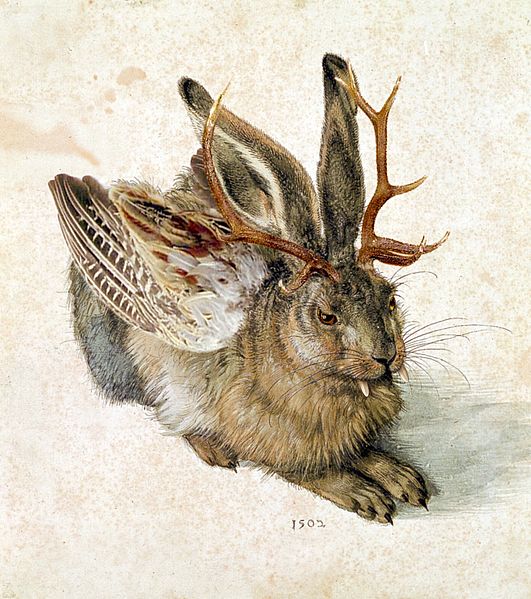 |
| The Wolpertinger. Picture from Wikimedia Commons. |
It is not the only creature of it's kind: in Germany alone, there are also the Rasselbock and the Elwetritsch, both chimaeric woodlands creatures in their own right. The American Jackalope and Swedish Skvader are also somewhat less extravagant versions of the Wolpertinger: the Jackalope lacks wings whereas Skvader is usually described as a winged rabbit.
Now, folklore likes fables and impossible creatures, so the tales of such beings are not surprising as such. What might be a bit surprising, however, is that when taxidermy became a bit more refined, the more skilled taxidermists started fabricating these creatures. As such.
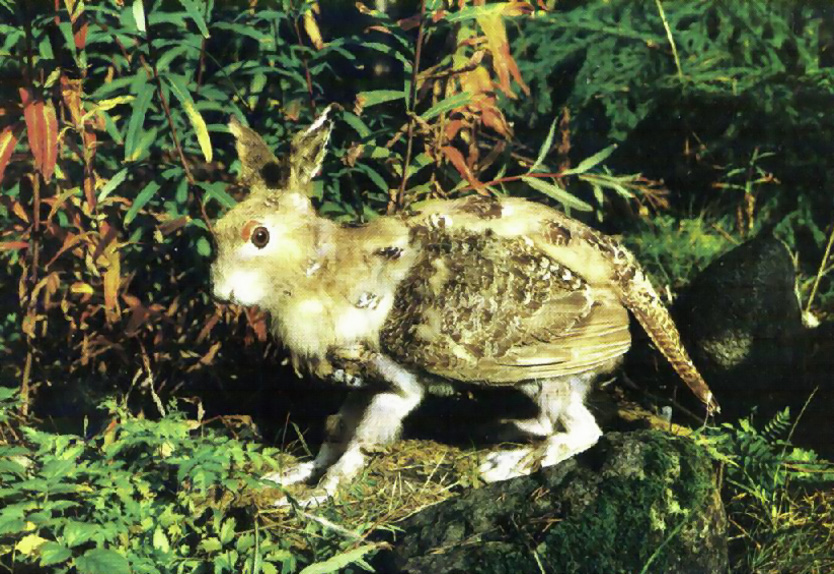 |
| Rudolf Granberg's prepared Skvader. Picture from Wikimedia Commons. |
Now, it's pretty odd that people should make up a creature, and then really make a creature that looks like the fabricated thing. And these taxidermic fabrications were really, really good. Some taxidermists even changed the bone structure of the creature to make it seem more real. I find it intriguing that people would knowingly create a fake copy of an imaginary thing simply to pass it as real. And not by photoshopping for 10 minutes, or even an hour, to create it: they spent weeks, maybe even months, sewing together a seamless replicated creature. To make a legend seem real.
Now, the final creature I will present today comes far from the East: the Kirin. The Kirin appears in almost all Chinese mythologies, as well as Japan. The Kirin has been described in many ways, but it's common traits are hooves and horns, tigerlike appearance, often a long neck and perhaps even a somewhat draconian appearance. A fearsome looking creature, it is still benevolent and only punishes the wicked.
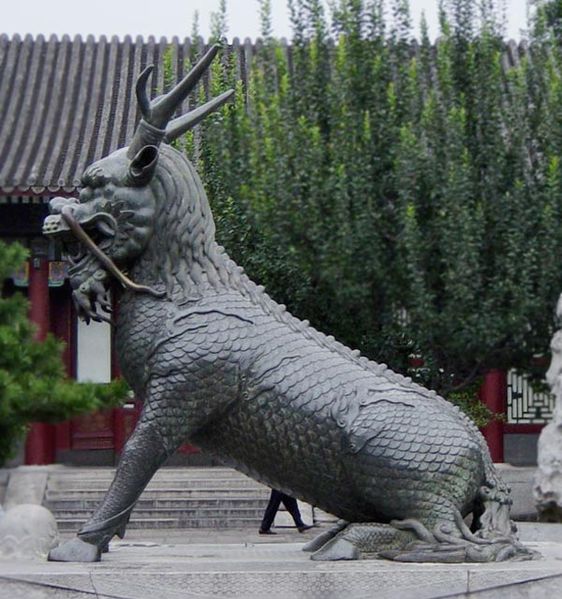 |
| A statue of the Kirin, in Beijing's Summer Palace. Picture from Wikimedia Commons. |
The creature in itself is not that odd as a fable: the tale around it largely resembles that of the Western unicorn. The queer part comes here. During the Ming dynasty, China had more contact with Africa again, and there met the giraffes. The Emperor had some brought back to the palace and noticed a resemblance to the fairy tale creature known as the Kirin. Thus, he proclaimed giraffes were Kirin, here to show all that he was a wise and benevolent ruler.
I'm not sure of the situation in other East Asian languages, but atleast in Japanese this proclamation still holds: Kirin means both the legend and giraffe. Perhaps not that many know why the two have the same name, but it all began with a single ruler.
Does humanity have some in-built need to find out if all the unbelievable stories are true, or is this realization of legends simply a means to make stories better? Or are all people essentially trolls?
Tilaa:
Blogitekstit (Atom)