torstai 12. joulukuuta 2013

In memoriam

Yes, slowpoke is slow. It's been a week now, but I wanted to do this because it kind of boomerangs back to me every now and then (also, I couldn't think of a verse that would suffice - I would have wanted to give something of myself, but it was not to be, and after a week of dallying I decided that a better verse by someone else would suffice).

I'm sure everyone's read someone's article on this already, so I will not sum up the life of Nelson Mandela here, and thusly I will try to be succinct. Mandela was, in my opinion, a truly great man - a person who genuinely believed in what he stood for, and stood for it to the end. Mandela was a force of peace, a lesson in forgiving and humility to all of mankind. To each is their time, and his was now. My only wish is that I could have met him in person. And for Nelson Mandela, if anyone ever, this verse of John Donne is most appropriate. You will be sorely missed.
 
 
No man is an island,  entire of itself; 
every man is a piece of the continent, a part of the main; 
if a clod be washed away by the sea, Europe is the less, 
as well as if a promontory were, as well as if a manor of thy friend's or of thine own were;  
any man's death diminishes me, because I am involved in mankind, 
and therefore never send to know for whom the bell tolls; 
it tolls for thee.

lauantai 2. marraskuuta 2013

Thor: The Dark World afterthoughts

I went to see the new Thor movie on it's local premiere, that being last Wednesday. Of course, a post like this would be preferable without spoilers, so I'll talk about that stuff later. This post will be a succint "yays and nays" type of a post.

Thor: The Dark World is good. I liked it better than the first Thor movie, although it was one of the better superhero movies that came out back in 2011. The Dark World improves on the first movie in many places, especially visually and thematically in many places. Where TDW fails in respect to it's predecessor, interestingly enough, is the plot.

The cover art actually tells a lot about the movie.
There's a lot of everything that doesn't really add up to a whole.

Thor: The Dark World is pretty, and it is pretty in a good way. The visualization of Asgard (and the other Nine Realms) has been, in my opinion, honed to a fine point. The feel of Asgard is fascinating, as is it's look. A lot of the jokes in TDW are funny, in what is now pretty much a standing trope in Marvel superhero movies. As the Marvel universe has had enough big screen appearances to have a good backdrop on it's own, even without the comics, The Dark World has a lot of backround material to fall back to, which it uses scarcely but effectively.

The characters are good - Thor's still Thor, Odin's still old, the Three Heroes are still heroic, Loki will still elicit squeals from the ladies... My two favorite displays of the movie, however, come from Idris Elba as Heimdal and Rene Russo as Frigga. Frigga is perhaps the best character in the movie, becoming during the movie, in my opinion, the scifi viking queen that the backdrop gives her the possibility to be.

While the movie is good, it has one largish drawback that often troubles the superhero movies. It outshadows it's own plot. It has a plot device, thrown in at the very start, and a looming bad guy. Then it trips over itself to get in all the guys that were in previously, everyone that someone might have liked, and jumps through hoops to play with the whole Yggdrassil - Nine Realms - connected worlds mumbo jumbo that's actually always been one of the more stupid parts of the Marvel Thor mythos. It all ends in a bit of a jumble, with Asgard sequences being rather awesome since the visual and style elements have been honed to a fine point. These are cut with drab sequences back on Earth, a few cuts here and there to the other nine realms, and it's all tied together by this huge, looming threat to end all of creation. Just like always.

Thor: The Dark World is pretty, from time to time witty, funny and engaging. It is, however, plotwise rather hollow. If you like superhero movies, I suggest watching it, but don't expect to be too surprised at any point. The Dark World is, apart from it's direction (which I think was mostly rather good, an astounding show from Alan Taylor who's mostly been doing tv series until now) and visuals, a cut and dry superhero movie. It's good, but it isn't astounding, it isn't mindblowing, it's nothing to write home about. I suggest watching it, but don't expect a spectacle.

keskiviikko 11. syyskuuta 2013

Failures in visual character building

I will use two case examples of visualized media to show where character building has failed in the new age bloody fantasy mindset that has gripped the world as of late.


My examples will be HBO's Game of Thrones, a TV adaptation of George R. R. Martin's novels, and the anime Shingeki no Kyojin or Attack on Titan, an adaptation of Hajime Isayama's manga. There will be spoilers, some more and some less heavy, so if you don't wish to be spoiled, stop reading after the next three paragraphs. There is an ending chapter at the very bottom of this post as well, with no spoilers..

Series with strong, well-rounded support casts are usually viewed as good. Real characters around the main cast make the story feel more real, better somehow. It makes sense: it's nice have people instead of stock figures around. You see this in well written books as well - you find out about the people around the main character(s) as well, because they are interesting too: they're people, just like the protagonist.

Now, both Shingeki and GoT are notorious for killing people. Practically all of them. One might think this puts a damper on the well-rounded supporting cast, since they'll spend most of their tome dead. This is partially wronk. In the print versions (books and manga) this works rather well: you meet a character, they're fleshed out over tens or hundreds of pages, they develop a persona. When they are killed, you feel a loss for their passing. It's sort of like someone you know, and then they're dead. In the visualized versions, however, the supporting cast are just so much cannon fodder.

From an analytical viewpoint, I understand what's happening. GoT is supposed to be gruesome: the whole point of the "King Wars" is that everyone is just flesh and blood, and if you fail once, that's it. Shingeki, on the other hand, is supposed to be hopeless - human kind stand no chance against the titans. And as I said, in the written stories (Martin's books and, so I've heard, the Attack on Titan light novel) this works splendidly. The manga does an ok job at this. But the visualized media ends up feeling a bit slapstick.

BE WARNED: YOU ARE NOW ENTERING SPOILER ZONE

Sadly, these pieces do not stand up to their written counterparts. With Shingeki no Kyojin, the problem lies a bit in the writing: the characters feel stock. At the beginning it doesn't matter that much: Armin's squad at Trost, all of the nameless Guard members, even Marco's deaths seem to actually carry a bit of weight, but they feel kind of pointless. As the story progresses, however, it gets more and more ridiculous. The underlining of humanity's inability to fight the titans is made abundantly clear in the Expedition Beyond the Walls arc, where the Female Titan rips apart most of the Scout Legion. To drive the point home, she eventually rips apart most of the senior Scouts, Günther, Erd, Petra, and Auruo. 

At this point, it trips over itself into the land of ridiculous. All of this is supposed to show the difference in power, but it feels needless. All we've learned during the anime about Captain Levi's squad is that they're supposed to be really good, then we see them do it for about 40 seconds, and then they die. The people dying could just as well be cardboard cut outs at this point, because everybody seems to die anyway. Both the characters and their deaths have lost their meaning, because the visual media doesn't have the time (or doesn't take the effort) to establish them.

The same problem lies with the Game of Thrones series. In the books, which are rather long, we get to know everybody rather well. In the series, people just end up dying one or two episodes up the road, with no real personality shown. As season three rolled about, a video was made that summarized the way people die in GoT rather well. While the event itself and the people that die in it are significant, it feels lackluster in the series, because it needs to chop up stuff so much that, again, everybody's dying all the time. Here is the video in question.


THERE BE NO MORE SPOILERS FROM THIS POINT ONWARDS

After all this rant, I get to my point. I feel that killing actual characters should be meaningful, even if it is to make the point of bloody war or hopelessness. If you kill one, or even five, to prove that point, that's rather fine. But if all of your characters end up dying because of the same thing (not so much true in GoT, just rather invisible in the tv series), the edge is lost. I no longer feel sorrow, or hopelessness, when people die in these two series. I'm exasperated. I don't care. The plot is dimmed because the deaths feel more the point than the plot, especially when they're often heavily underlined and at worst captioned, bolded and colored as well.

I like both of these series, but they just seem to be unable to build characters out visually, and end up the worse for it.

tiistai 16. heinäkuuta 2013

Mainstream Geeks

Biggest thing this week in gamer geek news has been this: League of Legends is an official sports in the USA. This is a stepping stone to the gamer world, a milestone. And it is pretty cool - the boundaries between online and offline are being torn down. You don't need to be in top physical condition to be an athlete - you can be something else entirely.

So, what else has been going on this year, concerning different kinds of geeks? Biggest Hollywood blockbusters this year: a movie about mechas thrashing it out and comic movies - Pacific Rim, Man of Steel and Iron Man 3 cropping up top. Everyone is trying to make the next Avengers movie. Games and comics are in. The places to be are E3, ComiCon, Playstation 4 and Xbox One launch events. Geeks are the popular culture.

What about Finland? Anime conventions are selling out, the Finnish Twitter is dominated by the anime and manga culture, and globalism makes all of what's happening elsewhere reflect here as well. What does all of this roll into, then, for geeks and geek culture?

We are mainstream. We won. Except we didn't.

Most of geek culture never wanted to be mainstream. It means we have the upper hand - we're no longer the epitome of a guy with coke bottle glasses that gets the stuffing beat out of him for his lunch money. We have to take responsibility now, instead of just shielding away behind the "we're the minority, everybody hates us" line. For the first time since the rise of geek culture, we would need to look at ourselves and see what's wrong on our side of the fence. And that doesn't come easy.

Sexism. Racism. Hateful slurs, hetero dominance, gay fear, oppression of belief. Not funny, eh? Log into almost any public game lobby, anonymous (or half-anonymous) online forum or any other public online agora where geeks compile and look around. We are the haters now, and have always been. It simply shows now, when we cannot shield behind being the bullied ones. This needs to stop. Yes, juvenile boys will be boys. No, we shouldn't feed the trolls. But that doesn't mean its ok, should be ok or will be ok to be a jerk to someone else, about anythingm, ever. The only way geek culture will "mature" is if we make it. If we, the ones who were the outcasts back in the 80's or the 90's, are actually at the center of what geek culture is, the change needs to begin with us. All of us.

We can't go around yelling "Everyone just hates us, boo hoo hoo!" anymore at every turn - we need to take responsibility for what happens on our turf. I wrote about games (specifically the newest Hitman game) in this regard about a year ago, and the point still stands. We can't do this shit. Not before, not ever, but especially not now. If we are the mainstream, we have the chance to be a better mainstream than it has ever been. But we need to start the change. We need to be better, not wait for the world to change. Man up, and take responsibility. Geekdom is no longer a hiding place. Get out there and change the world.

Edit: Looks like Moviebob said pretty much the same thing and more in a Big Picture episode a few weeks back. Go check it out at The Escapist.

keskiviikko 24. huhtikuuta 2013

Boston aftermath

About a week ago there was the horrible event of bombings at the Boston Marathon start line, that was followed by at least as horrible shootings and bombings during the rest of the week. Lives were lost, and we should reflect on what happened to be able to prevent such events from happening again. What I'm more worried about is the aftermath around the possible attackers and the responses that the chase and apprehension have evoked.

Situations like this should not be taken lightly. Bombings and random shootings are horrible and should be taken with all the seriousness. But what I was really taken aback by was the public and political response after the alleged still living attacker was caught (the highlighting there is important, so keep that in mind.)

I'm not taking a stand about whether or not Tsarnaev is guilty, there are professionals and such that will find out and decide that later, hopefully without bias or rancor. What was wrong, almost inhuman, to me, was the way people and the Republican party have reacted. People practically paraded out on the streets when the alleged attacker was caught - sure, he might have been guilty, but it's not yet sure, and there are some shady parts there. People all but whooped with bloodlust when he had been savagely beaten and was in a critical state, because it was felt that he deserved it.

A person that might have done horrible things deserved every imaginable deed of violence directed towards him. A person, a human being, that might have done something. Yes, what happened was horrible and yes, if he did it he should be convicted for it - convicted, not dragged through the streets like a rabid animal. The Republican party is calling for him to be treated as a non-American combatant - basically denying him all the basic human rights.

I understand that people, as a normal response to being in fear for a week, feel relief after they're told that the situation has been resolved. I understand that the relief might bubble out as joy, anger or other strong feelings that are directed in rather random directions. I refuse to understand the bloodlust and rancor people feel towards an alleged attacker. Even if he was the confirmed attacker, my god, would be butcher him like the Archbishop of Paris?

I understand the anger, the frustration of inaction and inability, the rage and sadness. I don't want to trod on anyone's loss. What happened was horrible, it was a tragedy beyond scope. But oh, humanity, a person - even after possibly committing horrid deeds - is a person, a human being, and should be treated as such. We are no longer savages, so let there be some humanity in how we act.

lauantai 23. maaliskuuta 2013

Smaller

When I'm sick, I always wish I was smaller. Not necessarily younger, but smaller. This would be because I get immense phantom pains when I'm sick, especially when I have a fever. It begins at the small of my back, an ache somewhere below the kidneys. When the fever rises a bit, the ache moves to the limbs: forearms, fingers and legs.

And, to top it all off, when the fever rises high enough, the pain moves to the skin. All of my skin burns, especially when touched. Clothes hurt, sitting hurts, showering hurts. And that's when I wish I was smaller, mostly because it would be nicer if the pain was... supressed, affecting a smaller area. If I was smaller, there would be less of me that could hurt.

I don't like being sick.

sunnuntai 17. maaliskuuta 2013

Foxfire

Well, the whole of Finland seems to be abuzz of foxfires, also known as aurora borealis or northern lights. I might as well jump in on the band wagon as it rolls by, so here are a few pictures from Jyväskylä.


It is a spectacular view, I must admit, and totally worth watching. I only saw greens tonight, but there's been a few pictures of purple tones up in the sky as well. The light show is still on in some places, so go check them out if you have the time.


keskiviikko 6. maaliskuuta 2013

Intouchables

- or how I restored my faith in humanity.

I watched Intouchables yesterday. It's a heartwarming, wonderful, brilliant movie and I wholeheartedly recommend it to everybody. I'll try not to spoil the movie as I go through the whys, but, once again, beware of spoilers. If you want to see the movie without any of it being spoiled, read this after you've seen it.

So, why is Intouchables such a good movie? Off the bat, it opens with an entrancing scene, immersing the watcher in the beautifully fitting soundtrack by Ludovico Einaudi. It's also fittingly cast, thoughtfully directed, well screened and the characters feel real. It makes sense they would feel real - the movie is based on a true story, after all.

The movie in and of itself isn't anything new or astounding: it's a growth story, it's about friendship, caring and courage. It's something that we've seen a thousand times before, in children's movies, in fantasy settings, in good-willing whole-family deals and all around in the kind of movies that air on tv during christmas. What makes Intouchables special is how real it feels. The characters act like real people: they're not cardboard cutouts, they do mistakes, tell horrible jokes, fumble and pick themselves up. They're afraid, they're in pain, they care.

And sometimes they dress up to smoke.

What made Intouchables spectacular to me was the amount of feeling they'd been able to put in there. There's some bumbling foolishness in the movie, but it's not the Adam Sandler -kind, it's real. It's the kind of goofy you might pull with a friend, and it's heartwarming. There's a scene where Philippe and Driss cruise around with the motorized wheel chair, and the whole point of it (atleast it seemed to me) is to make them feel real, feel like people.

What's most spectacular is how much you can feel the people care for each other. Even if it is underlined, even if it is "just a movie", it's based on a true story. Here we come to my secondary title. To me, watching a movie about people caring about each other - total strangers to begin with - that's based on real people, real friends, was the most spectacular thing. To know that there are people like this out there made the movie that much better.

My recommendation to everyone is to watch Intouchables if you haven't. Watch it alone, watch it with a friend, watch it at home or in the movies. Just watch it, laugh and cry and feel with the movie. It's definitely worth it.

tiistai 26. helmikuuta 2013

Accumulated worth

When I first started this blog, it was supposed to be named Accumulated Worth (as might be seen in the url). I chose something a bit lighter, but I've felt I should explain both the namesakes, because there's a rather interesting thought (atleast to me) behind them both.

The name of the blog, Vesinokkaeläimen Viinakaappi, translates to the Platypus' Booze Cabinet. This actually spawned largely from the want of an alliterative name and the need to think of something funny. I like platypi, I find the conjointment of different qualities charming.

You know, like this.


And Booze Cabinet's are the place you go to for ideas, relief, oblivion... Kind of what I use this place for, only the other way around. In the subtitle (or ingress, maybe) there used to be more of the platypus' flat mentioned, other places that this blog might be. And it's true, this place is a bit of a hodge-podge, a place where I come to vent, think and comment. This place isn't really aimed on some specific audience, nor is it a theme blog. It just is, and you kind of have to accept it for what it is or skim most of the stuff.

The url, accumulated worth, comes from Terry Pratchett's book, The Unseen Academicals. According to the cover, the book is about football and life in general, and while I don't so much care about football, I was very interested in what Sir Terry might have to say about life in general. I'll try to avoid spoilers, but if you intend to read the book and don't want to spoil the fun, you might want to to leave this for later.


The protagonist -  or atleast one of them - is Mr. Nutt, a (probably) goblin working in the candle vats of the Unseen University. The workers of the candle vats are, all in all, an odd bunch, basically refuse and lost souls from the world above. Amongst them is the hard-working, well-mannered Mr. Nutt, who is kept at arm's length mostly for what he is - a goblin.

Mr. Nutt can be seen as a commentary on many things, as can most things that Sir Terry puts on paper. What struck me the most about the character, though, is the dogma he lives by. There's a question that Mr. Nutt keeps on asking, especially towards the end of the book, when he believes himself to be a burden, a hindrance or a problem. "Have I accumulated worth?" All of Mr. Nutt's relationships are based on this little question, "Have I accumulated worth?" In Mr. Nutt's world, worth is something you must accumulate. You must be useful, helpful, skillful and able. If you aren't you don't have worth. Worth isn't inherent, it isn't handed out freely. Worth must be gained, and it must be stocked, because, like from a badly seamed flask, it will pour out eventually.

It's not a very happy view of the world, and it's not one that I would like to see people live by, not fully. But I can see worth in it, and I can see it in myself and the people around me. I think it is good, from time to time, to ask if you have accumulated worth to other people. Have you been useful, or helpful? I think everyone should be, whenever they can, but not because of worth - because it's the right thing to do. But this is a good way to try to keep measure of it.

What is worse, however, is that I see this around be a lot. It's mostly subconscious, something that's been hardwired into us so deep that we don't even notice it anymore. Ask someone about their weekend, for example. "Oh, I did nothing, I just sat at home." Now, if it was the first weekend in months that the person did this, the follow-up might be "and it was nice and relaxing for a change." But if it's the second, or third weekend of this in a row, the follow-up will much more probably be "I really feel like I should have done something" or "I'm so lazy all the time, it's horrible" or something along those lines.

We've been taught to think that worth is doing stuff, being busy. And, by model and teaching, we've been taught that we should be busy all the time, lest we lose worth. If we're not productive, we're not just neutral. We're a hindrance, a load on everyone else. We can't possibly take time for ourselves, for we would seize to accumulate worth for that time.

I think everyone should think about accumulating worth - it's good to think of someone else from time to time - but we should also think about ourselves. When it starts to get too hairy, ask yourselves: is worth all there is to it?

tiistai 19. helmikuuta 2013

Interactive storytelling


I wish to talk about storytelling in games - a subject I started on last week - by using a specific case example, The Walking Dead. I'll try to avoid spoilers about the plot, but those who have not played The Walking Dead and wish to get the most of the most out of it (and haven't been spoiled by anyone else) might want to stop reading here. Done? Alright, let's get going.

According to Telltale Games, the company behind The Walking Dead, it's an "adventure horror game series". Telltale Games has made episodic license adventure games their thing, with Tales of the Monkey Island and the Sam and Max franchise being the biggest ones until TWD. Now, The Walking Dead is based on Robert Kirkman's original comic book story that really hit the charts with Frank Darabont's live action series. It's basically a story about a zombie apocalypse, but with a sort of a twist. It actually focuses on the stories of the people that have survived instead of the surviving itself (for these, check every other zombie game from Left 4 Dead to Resident Evil).

The Walking Dead is a blast from the past - an adventure game. Adventure games were really in in the 1990's and for a while afterwards, but they've all but died out in the last five to eight years. Telltale Games is all about reviving this (back in the day) loved genre, and they're doing a more or less good job. What The Walking Dead isn't is as huge and unforgiving as the old adventure games - it's more like an interactive story where your choices count - it actually all but says it itself. It also plays pretty much like this.


The Walking Dead isn't that player intensive to play: lot of the events that come and go in the game are timed, even discussions: you only have a limited time to pick a talk option, or to solve a situation. What it focuses on are the choices: they're not easy, not black and white and they really do matter. The other characters remember what you say, and it changes how they speak and react.

The Walking Dead has an interesting feature: at the end of each episode, it takes five moral choices from the chapter and tells you how everyone else chose. I find it curious, since it anchors the already moral options into a larger frame. What did others do?

To me, The Walking Dead doesn't seem so much like a game - it's more like an interactive story and a pshychological exercise than anything else. If you needed to choose between two bad situations, which would you pick? If you needed to save someone and didn't have time to save everyone, who would you save? Who would you side with in a fight? How will you justify your choices to yourself?

I really like The Walking Dead. It's not much as a game, but it's a really good way to have a look at your own morals. I suggest it to everybody: it's a game for that will make you cringe, laugh, be angry and cry. It's sad moments are actually sad, the good moments actually good. The characters are real: they feel human and you can understand their choices - the why and how of their doings. It's got Clementine, probably the only six-year-old that's felt like a person instead of a midget stick-on you'd want to kick back to the sea. Try it, you might like it.

maanantai 11. helmikuuta 2013

Game writing

Gaming gets trodden on sometimes because it's "badly written", "stupid" or some other, rather similar descriptive terms. And it's true, often games are a bit stupidly written: the plots are overly evident, simplistic and clumsy - and gamers easily forgive this kind of stuff in favor of playability, because, as an acquaintance of mine put it, "you don't have time to listen to follow the plot if you're too busy shooting everything in sight."

I find this unfortunate. I wish that gamers - the core group that actually consumes games and game culture - would demand something better. Unfortunately a large portion of gamers are happy as clams to simply get the next FIFA, NHL and Battlefield off the shelves, which really isn't that good for originality, risk taking and cool new ideas in the gaming business.

Luckily, the fringe, underground and indie markets are slowly gaining ground. Services like the XBLA (Xbox Live Arcade), PSN Store (PlayStation Network Store) and Steam have made it possible for anything that seems marketable to be on the market. You could make your cool ideas into a real, finished product but have no means of marketing it? Now you do.

Now, "indie" or any other of these labels doesn't mean a game is good. Not even close. But it means that original ideas finally have a foothold on the business: you don't have to try to get a footing through the coder scene (although it still helps) - you can go to a broader audience straight off the bat.

This means there's a lot of, well, not that good games (I'd rather not use the term swill, although sometimes it feels apt) circulating out there: topical spinoffs of something that was good, with very minor tweaks to the gameplay as such. But it also means that sometimes, you find absolute diamonds: blasts from the past, with a polished, "now" kind of a finish; storytelling treasures, psychological exercises made interactive, explorations into the human psyche...

Game writing is often mediocre and sometimes downright bad. But sometimes it gives you a slice of life that is worth a good book or a great movie. I've played games that have made me laugh, cry and live the plot with the characters. On this topic, I'll be pondering the Walking Dead (the game, not the comic or the tv series) next time.

perjantai 8. helmikuuta 2013

Copyright Culture

Yesterday, the Europian Union Court of Human Rights made a declaration about the Copyright monopoly laws. Here's a news clipping about it.

"The European Court of Human Rights has declared that the copyright monopoly stands in direct conflict with fundamental Human Rights, as defined in the European Union and elsewhere. This means that as of today, nobody sharing culture in the EU may be convicted just for breaking the copyright monopoly law; the bar for convicting was raised considerably. This can be expected to have far-reaching implications, not just judicially, but in confirming that the copyright monopoly stands at odds with human rights."

You can read the full article here:
http://falkvinge.net/2013/02/07/court-of-human-rights-convictions-for-file-sharing-violates-human-rights/

I'm not going to discuss the whole article here, so I'll just summarize some points a bit outside it's area that I found important as well. In short, the European Convention outlines that an individual has the right to produce, reproduce and share culture and the current monopoly laws concerning copyrights limit this freedom, which is considered a base right of all human beings. It's a bit more defined and refined version of the 1st Amendment, for any American (or other) readers that may not be familiar with it.

There's been discussion about how the monopoly laws could be considered unjust, even degrading towards a single person, persona and personal rights, but no one's really done anything about it. Until yesterday. The EU Court of Human Rights in Strasbourg isn't exactly a small fish in this pond: it could be considered the single largest authority on issues concerning human rights, since the UN council and other chairs don't really give declarations anymore.

Some have lauded this as a victory for online piracy, which it is not. Piracy is still illegal, as it should be, but an individual is allowed to use and share culture without fear of unjust prosecution, what could be considered corporate blackmail and wholly unbased reimbusements that will leave an individual and his seventh son's seventh son in debt to a company that serves no one's rights, despite very vocal claims otherwise. It's still possible to get convicted for sharing content clearly owned by someone else, but now there needs to be a reason to do so in the EU.

What this is, is the first step towards copyright laws and copyright culture that could be viewed as even close to modern. It is a victory of the individual and the culture over unfeeling corporate power. (Not a socialist victory, just an individual one, mind.)

It's a start.

tiistai 29. tammikuuta 2013

Underlying themes

I'm not one to ban old books for racist or maybe-racist content: if we block the past, the risk of repeating it grows exponentially. Yes, Uncle Tom's Cabin, Robinson Crusoe and Huckleberry Finn display black people in rather unfavorable light. But that's how they were displayed back then.

If we block the popular culture of the past, we're sort of erasing history as we do it. And if we refuse to acknowledge that our history wasn't all sunshine and lollipops we run the risk of repeating it. What I'd much more rather see is people reading these books, Ten Little Nigger Boys still on the cover of the now Then There Were None and people actually discussing these things in their cultural context.

There's a movie out with just such a theme now: Django Unchained. I haven't seen it yet, but I can make a few educated guesses: it's a Tarantino movie, so it will be an overfluous splatter fest with a perverse liking to violence. I hope it will be a good story that forces people to think as well, but we'll see. No matter the presentation, the point is very much valid: cultural products are this are necessary if we are to remember the lapses in humanity that have happened before.

I think that even more important than having these sort of overt cultural products that point fingers and use light-up billboards is discussing the underlying themes in those that aren't as self-evident. As a case example, I'll use everyone's favorite dead guy at the moment, J. R. R. Tolkien.

You know, the guy that wrote this.
... and this.
Mr. Tolkien wasn't exactly a writer as such: he was an academic, a linguist and a historian (mostly in literacy), and very good at both. Tolkien is mostly the father of much of modern fantasy literature, both in good and bad. Tolkien was a good writer, although his focus in building worlds and languages made his stories a bit huge. The influence he had was in how he took classic folklore, changed it, and sometimes added completely new parts. For example, the pointy-eared, lithe and graceful elves of today are the work of Tolkien (much of their being has been taken from folklore fairie, though), as well as the short, stout and gold-greedy dwarves (again, a bastardization of old folklore, but the combination in itself is basically Tolkien's).

So, while giving us much of the loved, liked and known tropes of high fantasy, Tolkien also gave us the bad ones. The webcomic, Order of the Stick, had a pretty good strip on this some years back, on color-coded dragons: read it here. The point that the comic underlines and I'm trying to make is that Tolkien's work made all of fantasy monotone black and white: everything was based in very, very deep-set stereotypes. I'll throw around some examples to prove my point.

Elves are good: the first children of the Ilúvatar, a shining example of right about everything. They are the epitome of good and justice. Dwarves are greedy, taciturn and haughty: basically good by proxy, but often too proud and greedy for the good of anyone. Hobbits are magnanimous, have a penchant for food and rest but are basically good. Orcs and goblins are bad, period. Honestly, the only defining characteristic orcs and goblins have is that they're evil, serve evil lords, and want to kill all the good guys. That's it.

But harken, I hear you cry, humans are creatures of changing morals and many themes in the books. Sorry, nope. A character is either good or bad, and most of the time this is defined by one's race. The Eastlings and Southlings, people that are mostly defined as being strange, foreign and just not very much like us are, by default, evil.

I'm not saying what Tolkien did was wrong. I am saying that it built tropes that have hurt fantasy literature as a genre and made it very, very difficult to do anything different (for quite a while). I also think his stereotyping hurt his own writing, but that's a personal opinion.

If these things - innate racism, tropes, stereotypes - cannot be discussed, our culture is driven into an evolutionary cul de sac. Until then, the discussion is necessary.

perjantai 25. tammikuuta 2013

I believe in Batman

A lot of the 20th century pop culture revolves around vigilantism. To sharpen the focus, almost all of - at least the early - comics deal with the subject. I don't mean the newspaper strip comics, but the "real deal": (more-often-than-not) superhero comics and other such that come with the titular character's name usually printed on the front.

About like this.
Of course, the naming policy only became as it is somewhere around what's now known as "the Golden Age of Comics", going on from about the 1930's to the beginning of the 1950's. During this time, the world first met most of the comic book heroes (and a lot of the villains) that are still the most well known of the lot today, such as Superman, Batman, Captain America and Wonder Woman.

Back then, most of the comics weren't named after their main characters: Batman first showed his cowl in Detective Comics, while Superman began his career in Action Comics. The idea to name comics after the characters came during the later half of the Golden Age, when it was felt that characters such as Superman had grown bigger than the Detective Comics. Of course, there was the other thing, too.

As the Golden Age enveloped the second world war, most - if not all - comic book characters made their way into the happy world of propaganda (heck, even Donald Duck made fun of the japs and Hitler). Captain America was even born for this purpose only, and has had a bit of an uphill struggle to lose that mark ever since. While the original series of Action Comics kept it's boyish charms and direction, Superman flew off to embrace the stars, stripes and bald eagles to punch in the face of evil everywhere.

It made sense to make the super heroes fight the war: they were immensely popular among young boys, and if the boys thought it was cool to fight in the war like Superman, the homefront battle was halfway won. It also fit the vigilante status of the stiff-collared heroes like Superman to take the fight to the enemy if it was needed. It was, indeed, usual for the early age superheroes to be unquestionably good - to uphold the virtues everywhere. Superman, for one, is the ultimate boy scout and has kind of held on to that status all the way to today, despite some a bit grittier takes on him.

This is kind of why I like Batman better. Batman began as almost the same kind of moral absolute as the Man of Steel, but he's come a long way. Batman still doesn't kill, but he does what he needs to to uphold what he feels is right. The title of this post derives from the last Batman movie, the Dark Knight Rises, wherein Batman becomes the symbol of a Gotham that might be able to free itself yet from the ire of opressors, murderers and lunatics.

Seeing the movie again made me think about what Batman actually stands for, and here's my take. Do what you think is right, if you can unquestionably say that it is right, no matter the cost. This is what vigilantism as a thought is about, isn't it - the law is flawed, and thus there must be a force above the law, able to do what must be done.

This holds some very deep inherent flaws, pondered upon in Alan Moore's Watchmen (to give a comic book example, thus staying in only one source material). While the philosophical question of ultimate moral actor above the law is interesting, I don't find it plausible - human beings are not fully rational, and therefore are unable of ultimates. But, on a more everyday level, I find Batman a good thing to stand by. I believe in doing what I think is right, if I can hold it to the light. I don't believe in vigilantism, nor holding one's self above the law.

But I do believe in Batman.

tiistai 20. marraskuuta 2012

Muistatko

Muistatko, veikkonen, sen kultaisen ajan, kun kaikissa tietokonepeleissä juonella oli enemmän väliä kuin ulkonäöllä? Muistatko kun pelifirmat eivät vielä olleet mukana tehdäkseen rahaa vaan tehdäkseen mahdollisimman hyviä tuotteita?

Muistatko, kun Suomella meni hyvin, kaikki oli halpaa, työttömyys oli alhaalla ja olimme nousujohteessa, ihan ilman EU:ta? Muistatko ne hyvät ajat, kun karvakädet ja yön timot eivät vielä vieneet työpaikkojamme? Muistatko, kun veli venäläinen pysyi vielä rajan takana, eikä tullut tänne viemään meidän mökkitonttejamme? *

Muistatko kun kaikki olivat naapureilleen mukavia, elämä hymyili, ruoho oli vihreämpää, talvisin oli kylmä, laivat olivat puuta, miehet miehiä, naiset naisia, Suomessa suomalaisia ja viholliset ikiaikaisia aina talvisodasta lähtien? *

Muistatko ajan ennen kuin olit nostalginen?

Nostalgia nostetaan usein esiin hyvänä, hienona asiana. Onhan vanhojen muistelu kivaa, koska kokemukset ovat hienoja ja tärkeitä, ja jokainen kokemus vaikuttaa meihin ihmisenä. Kokemusten kertaaminen ja läpikäynti taas pitävät huolen siitä, että prosessoimme sen, mitä meille tapahtuu. Yhtälö ei ikävä kyllä ole näin yksinkertainen.

"Aika kultaa muistot." Ja niinhän se tekee, ei tuota sanontaa ole turhan päiten keksitty. Kun tapahtumasta on viikko, ovat muistot vielä kirkkaina mielessä. Mutta kun tapahtumasta on kuukausia tai vuosia, ei kaikkea muista, ja hyvää muistoa vahvistaa itselleen hyvänä kunnes kaikki negatiiviset puolet häviävät mielestä.

Nostalgia voi olla hyvä asia. Se voi vahvistaa oma-arvontuntoa ja tunnetta asioiden tärkeydestä. Helposti se lipsuu kuitenkin siihen, että menneisyyteen katselee kultasilmin ja muistelee, miten kaikki oli paremmin silloin vanhaan hyvään aikaan. Jos jotain kohtaan pitää olla kriittinen, niin omia muistojaan. Vahvistusvinouma on todella helppoa muodostaa, kun tarkistusraati koostuu yhdestä henkilöstä.

*Tarkoitukseni tai pyrkimykseni ei ole tällä tekstillä loukata ketään henkilöä tai ihmisryhmää, vaan käytän prototyyppisiä, usein kuulemiani nostalgian muotoja esimerkkeinä. Käyttämiäni kielikuvia voisi pitää rasistisina, mutta se ei ole tämän tekstin tarkoitus.

perjantai 9. marraskuuta 2012

Matkalla tulevaisuuteen

Yleensä teknologia ei hämmästytä minua arkipäivän tasolla: olen kasvanut teknologisen kehityksen kärkiaallon kanssa käsi kädessä ja ollut kaikesta uudesta riittävästi innostunut (samoin kuin scifi-intoilija), joten yllätykset ja hämmästyminen ovat yleensä harvassa.

Tänään, tällä hetkellä, aloin kuitenkin miettimään tämänhetkistä tilannettamme, ja ihan oikeasti hämmästyin. Kun siis.

Istun itse kirjoittamassa tätä blogitekstiäni läppärillä, samalla kun lataan päivityksiä kahteen peliin. Itsessään tämä on nyky-yhteiskunnassa melko arkipäiväistä. Teen sitä kuitenkin käyttäen puhelintani wifi-hotspottina samalla, kun lataan sitä verkkovirrasta. Tietokoneeni siis lähettää pakettipyynnön puhelimeeni, joka lähettää sen puhelinverkon läpi palvelimelle Ruotsiin, joka taas palauttaa pyydetyt paketit. Tämä koko hupi on nopeampaa kuin lankoja pitkin tullut internettini viisi vuotta sitten.

Kaverini tuossa pöydän toisella puolella taas on sateliitin välityksellä yhteydessä sekä pilvipalveluun, josta kuuntelemme musiikkia että ystäviimme Englannissa, reaaliajassa. Ja tämä kaikki tapahtuu mökillä, jonne ei ole edes tullut puhelinlinjaa yli kymmeneen vuoteen.

Aloin pohtimaan tätä, kun puhelimeni soi katkaisematta mitään äsken mainituista tapahtumista. Vaihteeksi hämmästyin. Hyvä näin, koska välillä on syytä muistaa, miten siistissä tulevaisuudessa me oikeasti jo tänään elämme. Hoverboardeja ei ikävä kyllä ole vieläkään, vaikka Paluu Tulevaisuuteen tuli ja meni, mutta ihan oikeasti. Siistiä.

maanantai 5. marraskuuta 2012

Hunting legends

- or the Wolpertinger, Jackalope and why they paint an interesting picture of culture at large.

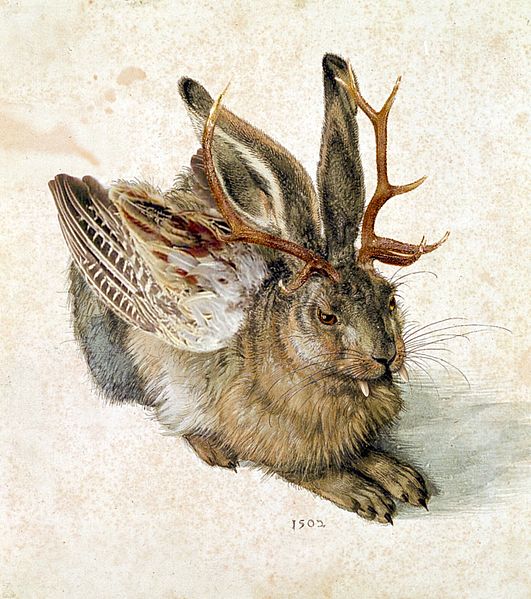
As all hallows eve has passed us by, I figured I'd say a few words about man-made legends. Horror stories are a thing for darker nights, so we'll discuss imaginary creatures today. My three examples for the presentation will be the Kirin, the Jackalope and the Wolpertinger.

The Wolpertinger. Picture from Wikimedia Commons.
The Wolpertinger is said to inhabit the forests of Bavaria, in Germany. It is a chimeric creature, a meat-eating rabbit that has fangs, horns and wings. Oh, and according to some legends it can turn invisible as well.

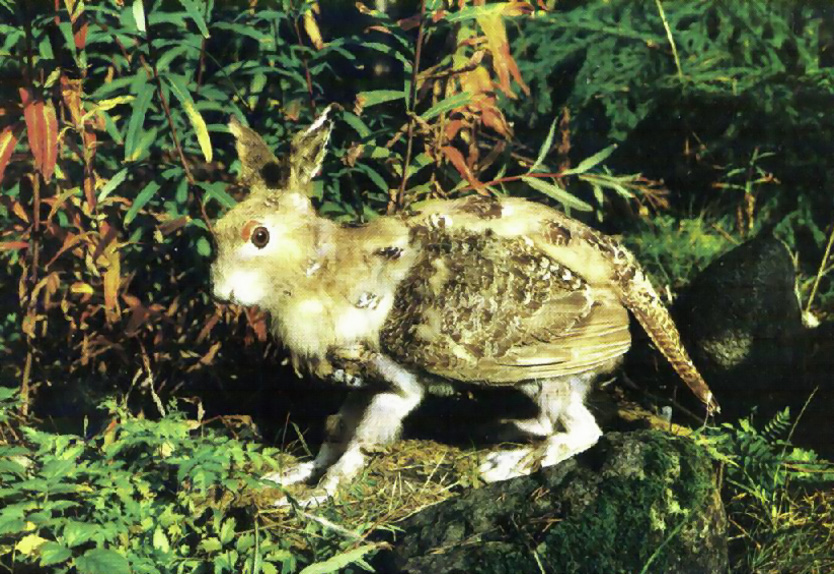
It is not the only creature of it's kind: in Germany alone, there are also the Rasselbock and the Elwetritsch, both chimaeric woodlands creatures in their own right. The American Jackalope and Swedish Skvader are also somewhat less extravagant versions of the Wolpertinger: the Jackalope lacks wings whereas Skvader is usually described as a winged rabbit.

Now, folklore likes fables and impossible creatures, so the tales of such beings are not surprising as such. What might be a bit surprising, however, is that when taxidermy became a bit more refined, the more skilled taxidermists started fabricating these creatures. As such.

Rudolf Granberg's prepared Skvader. Picture from Wikimedia Commons.
Now, it's pretty odd that people should make up a creature, and then really make a creature that looks like the fabricated thing. And these taxidermic fabrications were really, really good. Some taxidermists even changed the bone structure of the creature to make it seem more real. I find it intriguing that people would knowingly create a fake copy of an imaginary thing simply to pass it as real. And not by photoshopping for 10 minutes, or even an hour, to create it: they spent weeks, maybe even months, sewing together a seamless replicated creature. To make a legend seem real.

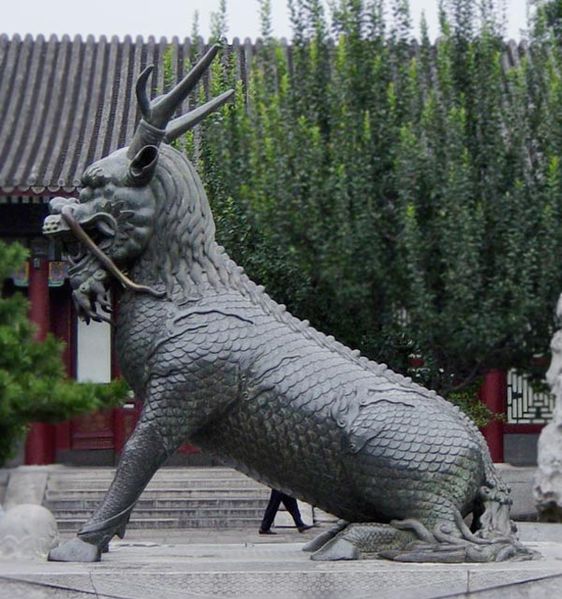
Now, the final creature I will present today comes far from the East: the Kirin. The Kirin appears in almost all Chinese mythologies, as well as Japan. The Kirin has been described in many ways, but it's common traits are hooves and horns, tigerlike appearance, often a long neck and perhaps even a somewhat draconian appearance. A fearsome looking creature, it is still benevolent and only punishes the wicked.

A statue of the Kirin, in Beijing's Summer Palace. Picture from Wikimedia Commons.

The creature in itself is not that odd as a fable: the tale around it largely resembles that of the Western unicorn. The queer part comes here. During the Ming dynasty, China had more contact with Africa again, and there met the giraffes. The Emperor had some brought back to the palace and noticed a resemblance to the fairy tale creature known as the Kirin. Thus, he proclaimed giraffes were Kirin, here to show all that he was a wise and benevolent ruler.

I'm not sure of the situation in other East Asian languages, but atleast in Japanese this proclamation still holds: Kirin means both the legend and giraffe. Perhaps not that many know why the two have the same name, but it all began with a single ruler.

Does humanity have some in-built need to find out if all the unbelievable stories are true, or is this realization of legends simply a means to make stories better? Or are all people essentially trolls?

keskiviikko 31. lokakuuta 2012

Everything must go!

Shave everything to grow a moustache! For cancer awareness!

Absurd? Quite certainly. Come tomorrow, it will be Movember, the month of moustaches and November. More specifically, a month where men are encouraged to grow moustaches to raise cancer awareness.

I have a moustache a year around. Of course, it is usually befriended by a beard that lives below it. Come the first of November, however, everything must go! While it might seem absurd, the point of the month is to begin with a clean slate. Enforcing rules to male facial hair for a month is a bit silly, but I'll take up the challenge. I'll even challenge any- and everyone reading this to do the same!

If you can grow a moustache - it need not be a thing of splendour, although that will of course make it all the more awesome - shape up and shave up on the morrow!

keskiviikko 24. lokakuuta 2012

"Promotion, promotion, one time only!"

Facebook offered me to "promote" my post today, saying that it would bumb it to a higher standing in the news feed and mark it as both "important" and "sponsored" for my friends. Harken, and bring me my lance, for the windmills need to be tilted at, promptly!

In other words (and excuse my French), what the hell? Fuck me sideways, if this isn't the second most stupid thing I've heard today (I'll get back to the most stupid thing in a few minutes). Now, I know Facebook is used by many for promotion and such, especially with elections all around, companies and whatnot. I also posted a video from Youtube, and have not noticed such a feature before, so this might be related with that as well. But, but - and I want you to hear that but clonking into place there, since it's especially heavy this time - why should there be a button to promote my posts above those of others in the first place?

I'm sure the part "sponsored" will put some extra weight on the post as a small subliminal stick-in in a corner somewhere, and that's sort of who Facebook is catering for. You're the little morsel that's being handed to the big boys that want your details and money, keep that in mind. This doesn't really tick me, although it's kind of sad to see people flock to a system that is made to sell the fact they're flocking to it. What ticks me is that I'm given the option to, in a sort of micro-transactory way, bump my message above those of my peers.

I know all of the people on my friends list personally at least in some way. I don't friend strangers on Facebook. So why should my message, my little nugget of comedy gold or insight of the day or perhaps a link to the "funny ha-ha" meme I found have the option to be more important than what the other friends that my friends have might have to say?

I have yet to see any of these sponsored messages crop up in my news feed, but I suppose it's only a matter of time. What I fear is that they will be given such priority that, to combat the tide, everyone will be forced to use the promotion system if they want to get their piece of mind out there. This system is made to be another gold mine to the company, without any real value. Instead of letting the reader decide what's important, this system let's the poster do it for them.

Now, the most stupid thing I've heard all day is this. It's a few months old, but it seems the idea behind it is still solid, so I'll give a brief summary. A man lost basically all of his internet user id's, everything he had in iCloud (basically everything) and the use of all his online handles because of very flawed online security services. There have been some arguments about "oh, no, it's the hackers" and some tin-foil hatters point fingers at the fact everything's linked. Both arguments are valid, as such, but at fault here are the asinine security protocols that allowed this to happen.

Basically, if you know someone's email, name and address, you can, from Amazon, get the last four numbers of their credit card number. Not a big deal, right? It's just four numbers. Meep. Wrong. Ever heard of a company called Apple? Yes, that one. Guess what you need to get into their databanks? Those same four digits. How's that for security? Every time you order a pizza with a credit card, someone gets the info to hack into your Apple account. From there, if you're an Apple user, they can wipe anything and everything using the iCloud: all the iPhones (no exceptions) and every Apple computer you might have linked with the system.  

That's the most stupid thing I've heard today, and since these two filled my stupid-quota, I'm going to bed.

sunnuntai 14. lokakuuta 2012

The devil you know...

Most people reading this will probably have heard the idiom in one form or another. Usually, in it's full form, it reads "The devil you know is better than the devil you don't." I've had a few discussions about how that could be interpreted, and have come to agree that it is rather open-ended when it comes to what this little string of words might mean.

In the modern world, the means of self exploration is usually psychology. Personally, however, I prefer a more philosophical approach. The forays that are made possible by mind games and personal monologue are, to me, more worthy than lengthy analysis into reflections of thoughts and actions. (Oh, and for those of you that actually know something about psychology, I know it's nothing like that, but I prefer the utterly personal touch of philosophy which I feel is missing from modern psychology - which is still better than anything Freud ever came up with.)

How do these two things link to each other, then? Well, each memory fort I build, thought exercise I undertake and each private monologue I have when cooking tells me more about me. It might not be important, it might not even be relevant, but every time I point the mirror at me, there is no other option but to atleast look at myself. And if I look, I have only two options: see, or avert my eyes.

This is the connection between the idiom and my point today. If I refuse to look upon myself, to reflect on my actions, thoughts and the ways I interfere with the world, I refuse to see what I am or am about to become. I become a stranger to myself. But if I look at what I have done and accept it - not accept as such, but accept that it has happened, it is there - I become the devil I know. And if I know me, I can control what I become. For every response I give, I can give a reason, or atleast a reason for why I don't have one. By reflecting, by looking oneself full in the eye, I can chain the beast and give it direction.

Here's a picture with no relation. This summer there were some really cool storms. I was nowhere near the hearth of any of them, but I was close enough to feel like daring the weather. Extremes are kind of awesome, from time to time.